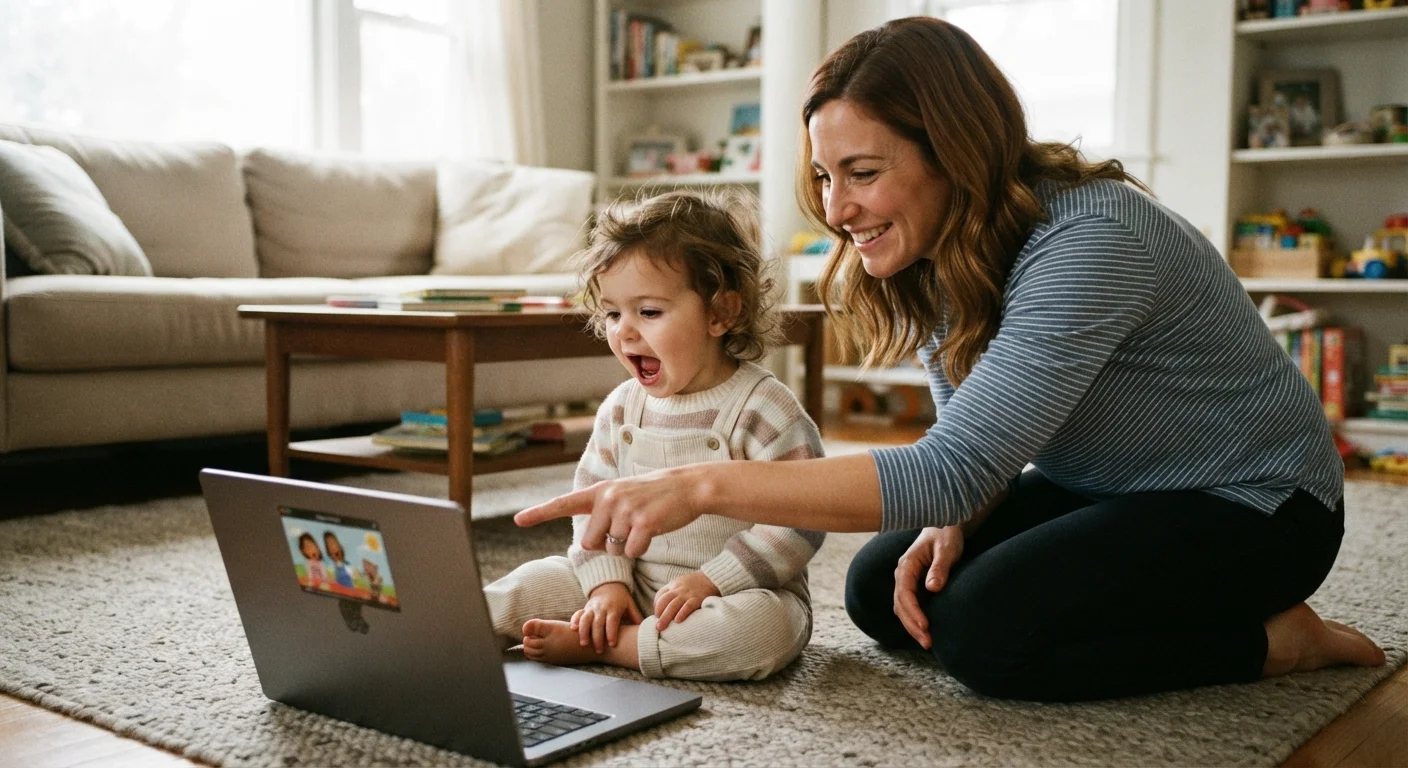
Miss Rachel’s videos build a toddler’s first vocabulary around a short, repeated set of words: mama, dada, hi, bye, up, more, all done, ball, dog, and banana. These are not random picks. They cover greetings, requests, and everyday objects a baby sees dozens of times a day, which gives a new talker the most chances to practice.
Who Rachel Griffin Accurso Is
Miss Rachel is the stage name of Rachel Griffin Accurso, a former New York City preschool teacher with a master’s degree in music education from NYU Steinhardt, where she trained to combine music and teaching for young children. She has also completed additional coursework in speech development and early intervention and is working toward a second master’s degree in early childhood education.
Her channel began after her own son had a speech delay. In an interview with NBC News, she said his first word came at two years and eight months, and it was “mama.” That wait shaped which words she chose to build episodes around: short, high-value words a caregiver can model dozens of times a day, not an abstract vocabulary list.
She built her early videos on techniques borrowed from her son’s early intervention speech therapist, with a focus on language milestones and inclusive content. That clinical starting point is part of why parents and some speech-language pathologists treat her word choices as more than entertainment.
The Word List Miss Rachel Teaches First
Across her most-watched first-words videos, the vocabulary clusters into a few practical groups. None of them require props beyond what most households already have.
1. Greeting And Connection Words
Hi, bye, mama, dada, and yes/no anchor almost every episode. These words get a toddler talking with people rather than just naming objects, and they come up naturally throughout a normal day, which means more chances to practice outside screen time.
2. Animal And Sound Words
Dog, cat, cow, duck, and their matching sounds (woof, meow, moo, quack) show up constantly. Animal sounds are often a toddler’s easiest early words because they don’t require precise mouth movements the way consonant-heavy words do.
3. Food And Mealtime Words
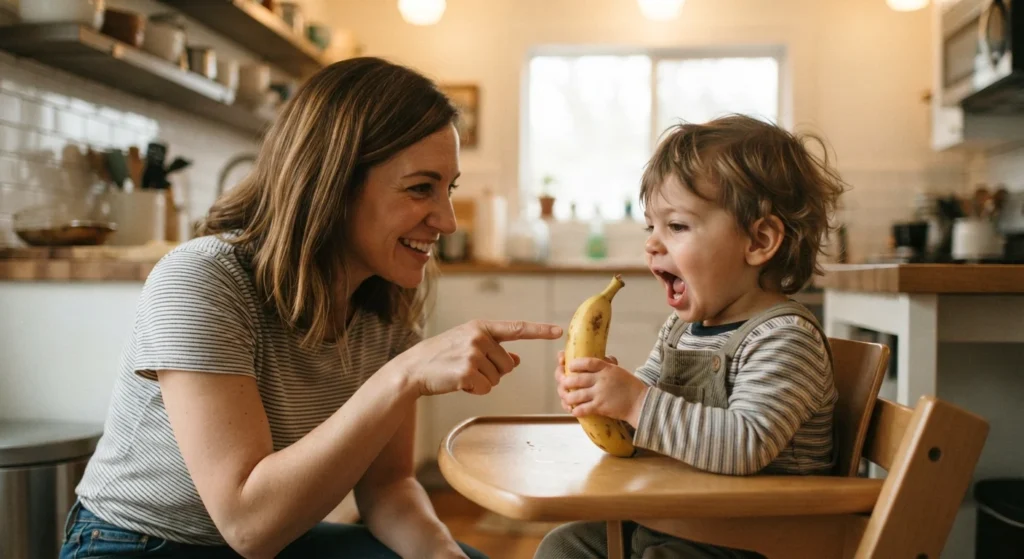
Banana, milk, more, eat, and all done appear in nearly every video that includes a snack or meal segment. “More” and “all done” double as functional words: a toddler who learns them gains a way to make requests and end an activity, not just label something.
4. Action And Routine Words
Up, down, go, stop, ball, book, and shoe come from her movement and play segments. These words pair naturally with a physical action, which research on early language shows helps toddlers connect a sound to its meaning faster than a word taught in isolation.
How Miss Rachel Gets Toddlers To Say New Words
The word list matters less than the pace it’s delivered at. Miss Rachel speaks slowly, pauses after asking a question, and repeats the same word several times in a single scene before moving on. That pause is deliberate: it gives a toddler time to process the word and attempt a response before the video moves forward.
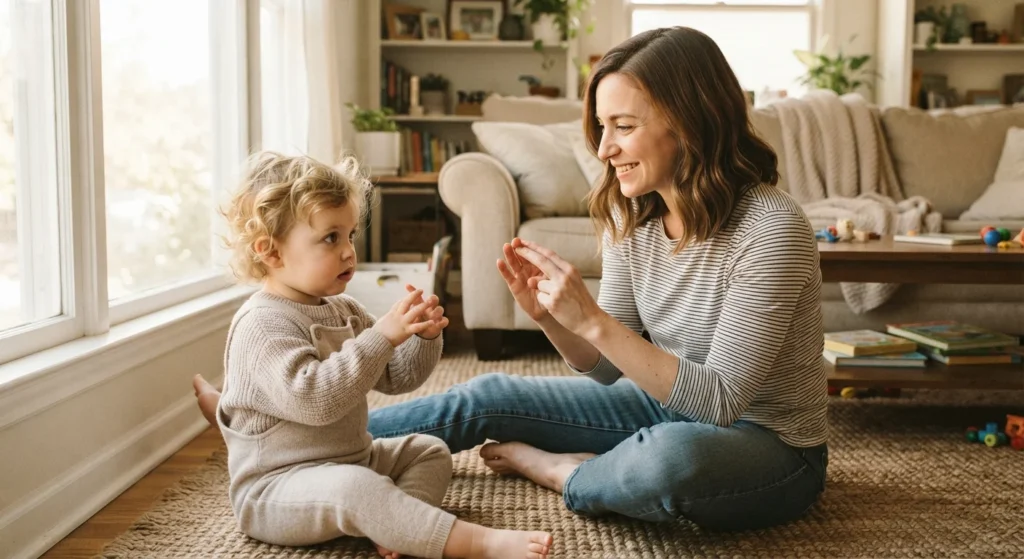
She also uses simple sign language alongside spoken words, a technique borrowed from early intervention practice. A toddler who can sign “more” or “milk” before they can say it clearly still gets to communicate, which reduces frustration and, according to several early intervention specialists, tends to support rather than delay spoken language.
Repetition across episodes reinforces the same core words in different contexts. A toddler hears “ball” during a song, again during a game segment, and again in a goodbye routine. That kind of spaced repetition, rather than a single exposure, is closer to how children build vocabulary in everyday life than a flashcard-style list would be.
What Real Speech Milestones Say About Word Counts
Parents searching for a Miss Rachel word list are often trying to compare their own toddler’s progress against a benchmark. The actual clinical numbers vary by source, and it helps to know that going in.
ASHA’s public milestone chart states that between 19 and 24 months, a child uses and understands at least 50 different words for food, toys, animals, and body parts, and starts combining two words. The CDC’s 2022 revised checklist sets a similar bar, expecting most 24-month-olds to use at least 50 words and short two-word phrases.
Speech-language pathologists interviewed by outlets covering this topic often use a wider range than the CDC’s screening checklist, since the CDC intends its numbers as a threshold for concern rather than an average. One frequently cited range puts a typical 18-month-old between 10 and 50 words, with wide individual variation even among children with no underlying delay.
This is a genuinely YMYL topic, so it’s worth saying plainly: word-count charts are screening tools, not diagnoses. If a toddler is behind the range for their age, the appropriate next step is a conversation with a pediatrician or a referral to a speech-language pathologist, not a longer video-watching schedule.
How To Use Miss Rachel’s Word List At Home
The word list only does work if it gets used away from the screen. A few specific habits make the difference.
Say the word Miss Rachel just modeled again, right after the video pauses, while pointing at the real object in the room. This bridges the screen word to a toddler’s actual environment, which is where most vocabulary actually gets used.
Pick two or three words from a given episode to repeat throughout the day rather than trying to reinforce all of them. A toddler who hears “more” at snack time, during a game, and at bedtime gets far more repetitions than one who hears twenty different words once each.
Narrate ordinary routines using the same short words instead of full sentences. “Dog. Big dog.” lands better for a brand-new talker than “Look at that big dog over there,” because it isolates the target word instead of burying it in a sentence.
When A Word List Isn’t Enough
A word list, however well researched, is not a substitute for an evaluation. If a toddler is 18 months old and has fewer than 10 words, isn’t combining gestures with sounds, or has stopped making progress they’d previously shown, that’s a reason to talk to a pediatrician rather than wait for a video to close the gap.
Every U.S. state runs a free early intervention program for children under three, and a referral doesn’t require a diagnosis first. Miss Rachel’s own content exists because a real evaluation led to real strategies for her son, not because a video alone solved a speech delay.
For most toddlers, though, a short rotating list like the one above (mama, dada, hi, bye, more, all done, ball, dog, banana, up, down) gives a realistic, research-informed starting point. The words work because they get repeated constantly, both in the videos and in the ordinary moments of a day, which is closer to how first words are actually learned than any single list could be on its own.